
Protocol
Sagitta Protocol
A fiduciary-grade protocol doctrine for autonomous capital continuity, reserve-backed protection, and deterministic settlement.
Identity, scope, and fiduciary posture
Sagitta Protocol is an autonomous, fiduciary-grade investment engine that enforces trustless capital management through continuity governance and gold-backed insurance.
Scope Clarifications
- Sagitta is protocol infrastructure, not a bank, trust company, or discretionary custody operator.
- Capital behavior is governed by deterministic protocol law and invariants, not operator judgment.
- References to insurance describe internal reserve mechanics, not external insurance contracts.
Fiduciary Alignment
- Principal protection is enforced as a first-order invariant.
- Loss absorption follows predefined settlement ordering.
- Performance is evaluated relative to reserve protection.
- Growth is bounded by reserve coverage and earned solvency.
- Authority is separated across custody, policy, insurance, and continuity.
What this protocol refuses to do
These are hard constraints, not policy preferences.
- No discretionary human override during stress-mode continuity transitions.
- No growth expansion that violates reserve coverage thresholds.
- No settlement path that bypasses protocol-level loss accountability.
Capital flow under stress
When depegs, venue failures, or governance compromise occur, routing shifts in deterministic order:
- 1. Threat detection and protective contraction.
- 2. Escrow exposure isolation and execution throttle.
- 3. Reserve absorbs protocol-level downside in defined order.
- 4. Continuity Engine applies substitution and evacuation doctrine.
- 5. Deterministic settlement and staged recovery.
Executive Summary
Whitepaper text integrated into protocol sections
Problem Context
Modern capital allocation systems expose participants to layered risks without enforcing commensurate protection. Yield optimization, leverage, discretionary governance, and dependency on external infrastructure frequently transfer downside to users while insulating decision-makers.
Sagitta addresses this problem by treating capital protection, loss accountability, and survivability as first-class system requirements, not secondary features.
Protocol Overview
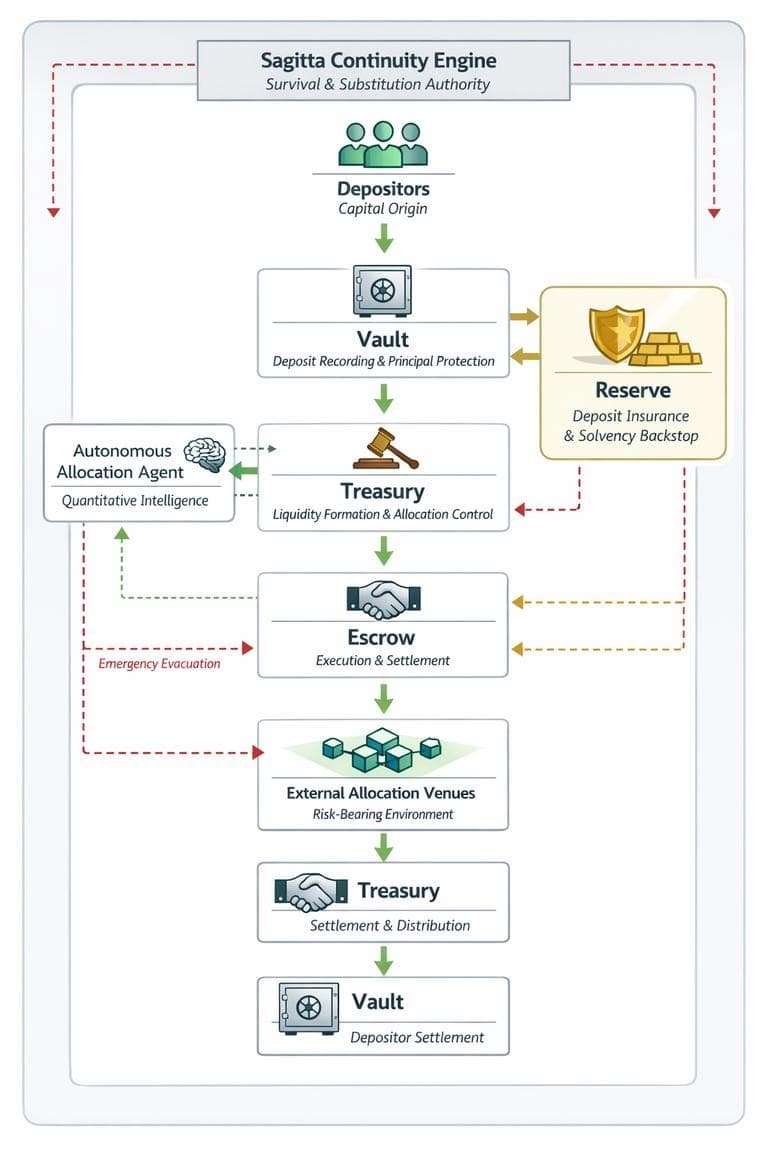
Sagitta is composed of distinct, cooperating subsystems, each operating under defined authority boundaries:
- Vault - protocol-level custody and accounting for contributed capital.
- Treasury - monetary authority governing liquidity formation, allocation batches, and settlement.
- Reserve - capitalized, gold-backed insurance layer protecting participant principal.
- Autonomous Allocation Agent - quantitative intelligence providing risk-aware allocation recommendations.
- Escrow - isolated execution boundary interfacing with external allocation venues.
- Sagitta Continuity Engine - survival authority governing evacuation, substitution, and reconstitution under failure.
- No single subsystem is indispensable. Authority is layered to prevent risk concentration.
Capital Protection and Fiduciary Discipline
Sagitta enforces fiduciary alignment structurally.
Participant principal is protected through reserve-backed insurance and deterministic settlement. Allocation underperformance is absorbed at the protocol level through ordered loss handling rather than passed to participants. Growth is constrained by insured capacity, ensuring solvency precedes expansion.
Fiduciary behavior is enforced by protocol law rather than operator intent.
Survivability and Continuity
Sagitta is designed to operate under adverse conditions, including:
- Allocation losses.
- Stablecoin depegs.
- Reserve asset volatility.
- Governance compromise.
- Execution or counterparty failure.
- Blockchain-level disruption.
- The Sagitta Continuity Engine governs response through predefined doctrine, ensuring depositor protection and system solvency persist during evacuation, substitution, and recovery.
- Survival is treated as a deterministic system function.
Architecture Stack
Layered authorities inside Sagitta Protocol
Vault
Protocol custody and accounting authority.
- Records contributions and ownership state.
- Maintains deterministic availability for protocol accounting.
- Separates user capital records from allocation decisioning.
Treasury
Monetary coordination and settlement authority.
- Forms allocation liquidity from protocol inflows.
- Applies policy constraints before execution.
- Reconciles outcomes with reserve-aware settlement logic.
Reserve
Capitalized insurance and shock-absorption layer.
- Buffers volatility between vault obligations and allocation outcomes.
- Absorbs losses through defined drawdown priorities.
- Operates passive, active, and emergency stabilization modes.
Escrow
Execution boundary and directional safety valve.
- Isolates external allocation exposure from core accounting layers.
- Captures a defined share of positive outcome flow.
- Releases value under doctrine thresholds and continuity checks.
Autonomous Allocation Agent
Quantitative risk and allocation intelligence layer.
- Runs periodic policy cycles using market and protocol telemetry.
- Produces target allocation weights and risk posture outputs.
- Feeds continuity-aware constraints back into treasury execution.
Continuity Engine
Survival governance and failure-response authority.
- Tracks stress signals and system health regimes.
- Triggers protective mode transitions during failure events.
- Coordinates evacuation, substitution, and staged recovery.
System invariants
- Participant principal remains protected as a system constant.
- Reserve floors and insurance constraints are binding limits.
- Escrow disbursement is gated by doctrine thresholds and health state.
- Risky allocation authority is reduced when system health degrades.
- Sustained drawdown conditions force continuity-biased behavior.
- Settlement remains deterministic across normal and stressed regimes.
Capital flow lifecycle
- 1. Vault records and protects contributed capital state.
- 2. Treasury forms deployable liquidity under policy and reserve constraints.
- 3. Autonomous Allocation Agent computes risk-aware allocation targets.
- 4. Escrow executes isolated market interactions and returns outcomes.
- 5. Reserve absorbs stress and continuity doctrine enforces survival behavior.
- 6. Settlement closes each cycle with deterministic accounting.
Protocol Diagram
Capital Flow Diagram
Custody, reserve insurance, allocation execution, settlement, and continuity controls in one operating map.
Failure and threat matrix
The whitepaper defines explicit scenario-to-response logic to keep the protocol inside survivable operating bounds.
Slow drawdown
Reserve dampening with gradual de-risking.
Flash volatility spike
Continuity mode with strict risk reduction.
Vault outflow surge
Priority routing and tighter liquidity controls.
Reserve depletion pressure
Automatic protective posture and allocation contraction.
Escrow imbalance
Rebalance doctrine and delayed release conditions.
Allocation drift
Deterministic corrective weighting by policy cycle.
Need protocol implementation guidance?
Use the docs page for full chapter references, then contact Sagitta Labs for architecture review and deployment support.
Go to Docs