
Whitepaper Chapter
Capital Flow Diagram
Lifecycle sequencing for capital movement and settlement.
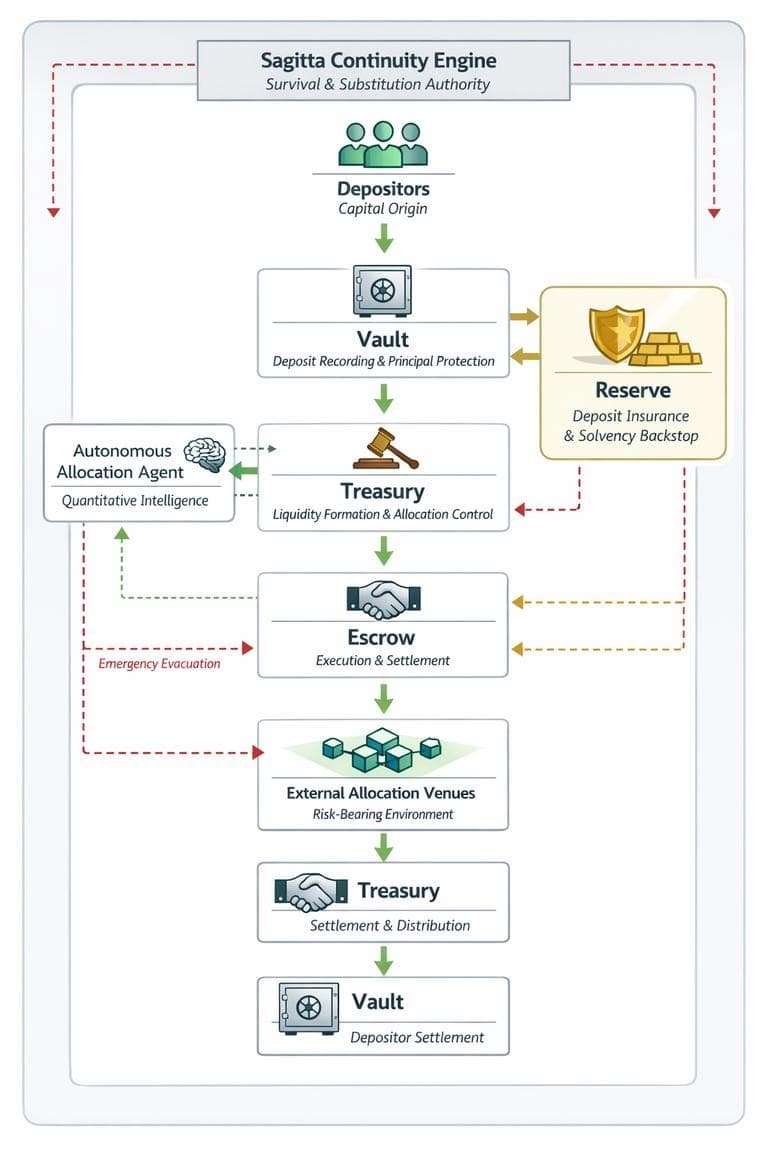
The capital flow diagram is the operational map for how Sagitta capital moves, where authority changes hands, and how protection is enforced.
1. Purpose and Interpretation
The diagram is a doctrinal model, not a UI flow. It encodes custody, execution, insurance, and continuity relationships in one deterministic sequence.
Each arrow represents bounded authority transfer and settlement responsibility.
2. Core Flow Sequence
Primary capital path:
- Depositors -> Vault (capital origin and principal recording).
- Vault -> Treasury (liquidity formation and allocation control).
- Treasury -> Escrow (isolated execution boundary).
- Escrow -> External Allocation Venues (risk-bearing environment).
- External Venues -> Treasury (settlement and distribution logic).
- Treasury -> Vault (depositor settlement and accounting closure).
3. Supporting and Protective Flows
Parallel safeguards shown in the diagram include:
- Reserve insurance routes that absorb losses before depositor impact.
- Autonomous Allocation Agent signals feeding treasury policy cycles.
- Continuity-engine evacuation and substitution paths under stress.
4. Diagram Semantics
- Solid green arrows denote nominal operating flow.
- Dashed red/yellow lines denote emergency and substitution pathways.
- Subsystem grouping emphasizes layered, non-monolithic authority.
5. Summary
The diagram demonstrates that Sagitta is a coordinated authority stack with deterministic protection logic.
Capital flow is structured to preserve principal, enforce accountability, and maintain continuity during failure.
Need implementation support?
Use these chapter pages for local review, then contact Sagitta Labs for architecture and deployment guidance.
Contact Sagitta Labs